
“One might have thought it was some kind of caravan… Or an old army returning after a huge raid with captives and loot”: this is how Philippe de Ségur, a close aide to Napoleon and later a historian, described the sight of dozens of carts loaded with what had been plundered from the former Russian capital in 1812 as they left Moscow. By RBTH
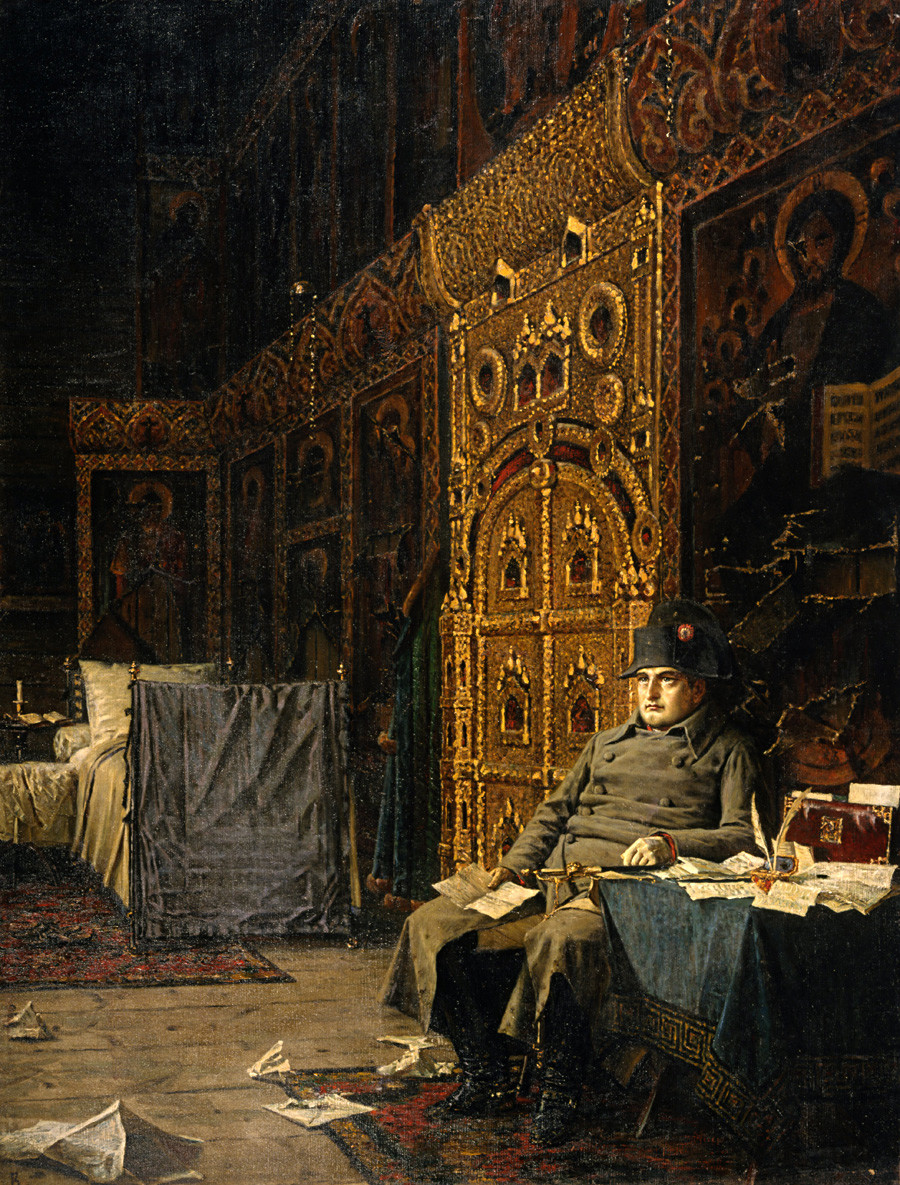
Foundries in Churches
The fate of these trophies is still unknown. There are reasons to believe they never left Russia. An explorer and treasure hunter, Vladimir Poryvaev, claims that a list exists of the treasures Napoleon’s troops took from Moscow. “The items mentioned were neither sold at auction nor integrated into private collections. This means that Napoleon’s treasure did not leave Russia, and it must be sought here,” Poryvaev stated (the article is in Russian).
Read also: How Moscow’s Trap Closed on Napoleon
These 200 carts also contained objects stolen from Moscow’s inhabitants. According to historian Alexander Seregin, the French mercilessly plundered 15,000 Moscow residences. “The most disgusting thing was what they did in churches and monasteries. They took icons, tore off jewels… They melted everything on site because there was a furnace in every church. The precious metals were melted into ingots and stamped with the letter N. All of this took place over a month. This appalled Napoleon himself, who issued a decree demanding an end to the looting,” the historian said in a television programme (the programme is in Russian).
It is said that among the stolen items was the golden cross from the Ivan the Great Bell Tower, Moscow’s tallest building. According to some accounts, Napoleon wanted to place it on the roof of the Invalides residence in Pariswhere he planned to create a museum of the conquered Nations.
Walter Scott’s Indication
The most popular theory states that Napoleon hid the stolen treasures during his retreat from Moscow in the autumn of 1812. Although the French emperor managed to take the city, he could not defeat the Russian forces. Thus, he had to retreat hastily under constant attacks from Russian regiments. Somewhere along his path, the carts with the loot began to constitute too heavy a burden, and the emperor ordered the trophies to be hidden, which, according to some estimates, included 80 tons of gold.
Read also: Sweets, Cakes, Vodka… How Russia Fell in Love with Napoleon
According to Ségur, the French threw them into Lake Semlevskoye near Vyazma (300 kilometers west of Moscow). It is believed that Napoleon himself stopped in the village of Semlevo while fleeing Russian troops. Ségur’s statement was later repeated by the Scottish writer Walter Scott in his book The Life of Napoleon Bonaparte, Emperor of the French.
The Mystery of the Lake
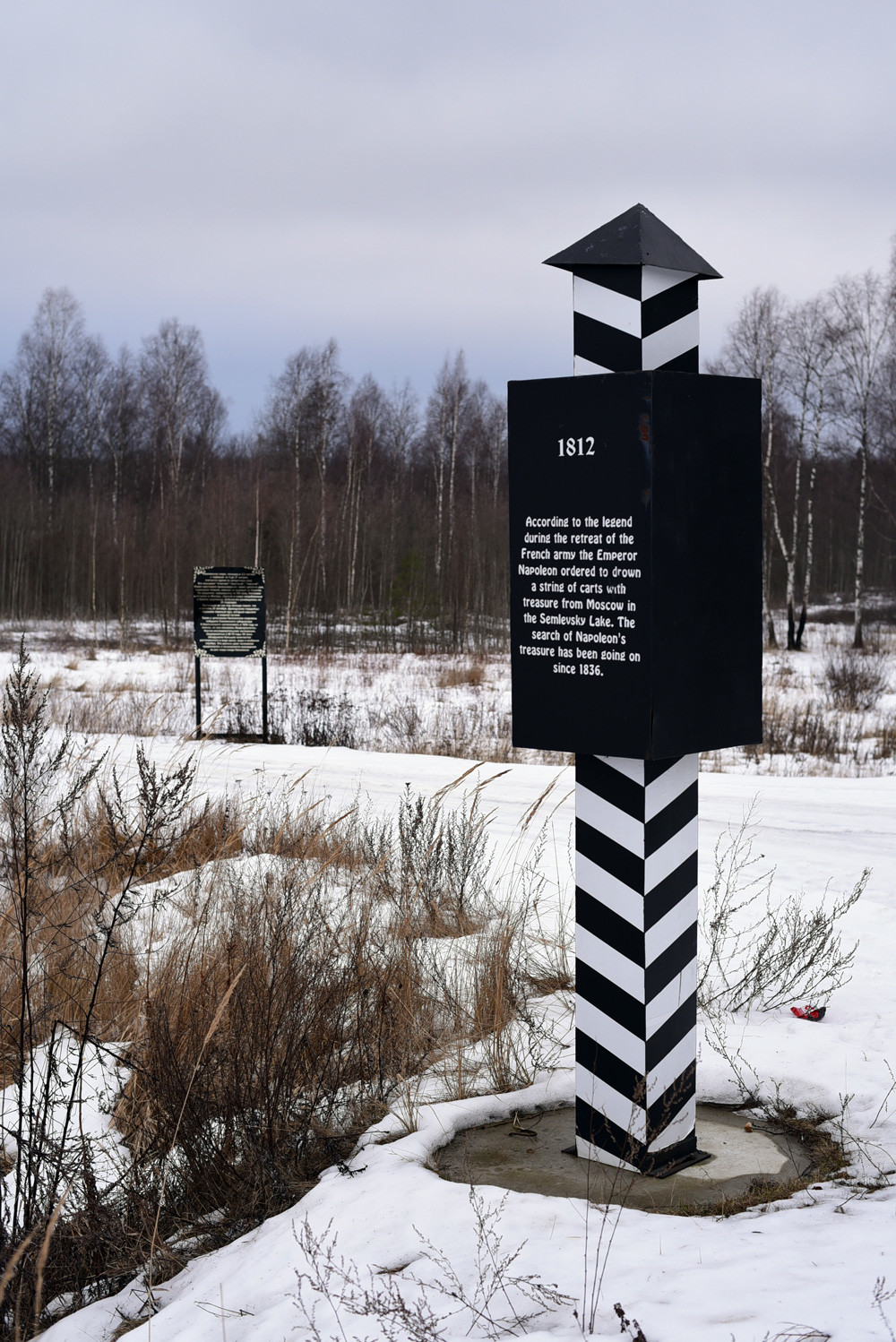
Lake Semlevskoye
Legion Media
Immediately after the war, many different types of ammunition were found near the location in question, as well as remnants of rifles. The search for the gold in Lake Semlevskoye began as early as 1830 after the publication of Scott’s book. In 1836, the Governor of Smolensk, Nikolai Khmelnitsky, invested heavily in exploring the depths of the lake, but to no avail. At the beginning of the 20th century, the archaeologist Ekaterina Kletnova tried her luck, but she too achieved no results.
During the USSR era, there were several attempts to explore the lake’s waters. The best-organised expedition took place in the late 1970s. Andrei I, now an actor and television presenter and at the time a diver, recalled the details of this expedition in a television programme (the programme is in Russian).
Read also: Top 10 Mysterious Lost Treasures of Russia
“We worked meticulously and systematically. First, in winter, topographers drew a precise map of the lake. Then geophysicists and geochemists began their work. Two serious anomalies beneath the ground were revealed… Regarding the first, it was not in the water, but near the lake; we used an excavator that dug a huge hole 12 meters deep. We searched the bottom of it but found nothing. For the second anomaly, we installed a water monitor. Divers dug a hole at that spot. At the bottom of the well, the divers only discovered a huge stone.”
At the same time, Lake Semlevskoye is not the only place where explorers are searching for Napoleon’s treasure. According to Poryvaïev, it is worth looking for it near the Berezina River in present-day Belarus, where French troops fought a battle against the Russians and lost a large number of soldiers and many items stolen in Russia. Several search groups have worked there. In 2012, a joint French-Belarusian team excavated the site, but they did not find the trophies.
Thus, the mystery remains unsolved…
The Russian court was once one of the richest in Europe. Russia Beyond revisits for you the five most mysterious stories associated with imperial treasure objects.
Source: Russia beyond the Headlines