
Photo Katherine Wetzel @ Virginia Museum of Fine Arts
Carl Fabergé created 50 Imperial Easter eggs for the Russian Tsars Alexander III and Nicholas II, as well as for their consorts. Some of these eggs, beginning with the 1893 Caucasus Egg, feature dates either directly on the egg or on the surprise contained within, or place names indicating where the commemorated event occurred. Uniquely, only two of these eggs bear written messages in the Old Church Slavonic style.
These are the 1898 Pelican Egg and the 1915 Red Cross Imperial Egg (The Fabergé Imperial Easter Eggs, Tatiana Fabergé, Lynette G. Proler, Valentin V. Skurlov – CHRISTIE’S, London, 1997, pp. 133-135), both presented by Tsar Nicholas II to his mother, the Dowager Empress Maria Feodorovna ( Since the end of the 18th century, German and Dutch princesses who married Russian Grand Dukes received the patronymic name “Feodorovna” in honor of the holy relic of the Romanov house – the 12th-century icon of the Feodorovskaya Mother of God. http://www.alexanderpalace.org. Among the new members of the Imperial family who received a new name after their conversion to Orthodoxy were Maria Feodorovna (wife of Paul I), Alexandra (wife of Nicholas I), Maria Feodorovna (wife of Alexander III), Alexandra (wife of Nicholas II), and Elizabeth Feodorovna. ).
These two eggs bearing inscriptions are currently in the collection of the Virginia Museum of Fine Arts in Richmond, Virginia, USA. They entered the museum’s collections in 1947 through the bequest of Lillian Thomas Pratt, an art collector and philanthropist.
It appears that the messages these two eggs were intended to convey have not been studied in depth until today. The combined effect of text and symbols, so carefully crafted together, has been lost, primarily due to hasty translations.
A closer examination immediately raises a number of important questions:
Who made the decision to include such messages in the very design of the object? What relationship could have existed between the craftsman and his patron to justify the creation of such a significant and enigmatic object? To what extent do the symbols it contains reflect the understanding of the era? What do these messages mean in the specific context of each egg?
The following observations and analyses focus on the biblical inscription of the Pelican Imperial Easter Egg, placed within the context of Russian history. This is the first known study of these complex and elusive questions, sparking increased interest in the Red Cross Imperial Egg and the connections and meaning these eggs may hold for their creators, owners, and viewers, whether past or present.

Photo Katherine Wetzel @ Virginia Museum of Fine Arts
Lost in Translation
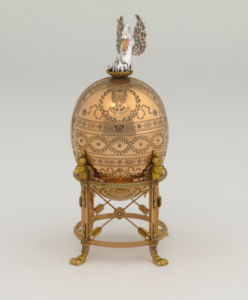
In 1897, the Department of the Institutions of Empress Maria, responsible for educational and charitable establishments in Russia, organized a grand celebration for the centenary of its foundation ((http://encblago.lfond.spb.ru)). To commemorate this event, in the spring of 1898, Tsar Nicholas II presented his mother, Dowager Empress Maria Feodorovna, with a gold egg crowned by an enameled sculpture representing a nesting pelican, its raised wings set with diamonds.
The egg rests vertically on a delicate stand. The commemorative dates 1797-1897 are engraved on the lower part of the metaphorical shell, while on the upper slopes, just beneath the pelican’s nest, are engravings: on one side, a nesting pelican surrounded by a laurel wreath; on the other, vines on their stems also surrounded by laurels. Above the pelican, on the front face, one can read in an arc: И ВЫ ЖИВЫ БУДЕТЕ (“and you shall live also,” plural). On the opposite side, a similar arched inscription appears above the vines: ПОСЕТИ ВИНОГРАДЪ СЕЙ (“visit this vine,” singular).
When opened, the egg reveals a surprise: eight oval painted miniatures representing educational institutions in Saint Petersburg and Moscow, mostly known as the Mariinsky Institutions (of Empress Maria) “for the education of noble young ladies.” Only eight of these institutions are represented ((http://www.mieks.com/research/pelican-intro.html)), among many other charitable establishments, including colleges, hospitals, orphanages, and societies, of which Dowager Empress Maria Feodorovna was a passionate and devoted patron. Each ivory miniature is mounted on a thin gold oval plate bearing the engraved name of the institution depicted on the obverse. The inscriptions mentioned above also appear at the top of the oval frames of the miniatures, to the left and right of the central ornament representing a pelican. To the left, above the miniature of the Patriotic Institute, founded in 1827, is the inscription ПОСЕТИ ВИНОГРАДЪ СЕЙ; to the right, above the name of the Pavlovsky Institute, founded in 1798, the inscription И ВЫ ЖИВЫ БУДЕТЕ.
Detached from its original owner and then from Russia, this work of art and history of great importance gradually became an enigma, harboring several layers of coded meanings ((Indeed, several websites refer to the eight institutions represented as having been founded by Dowager Empress Maria Feodorovna, when in reality they were created in the 18th and 19th centuries by different members of the Imperial family – hence names like Smolny Institute (1764), Pavlovsky Institute (1798), Nikolaevsky Orphanage (1837), Xenia Institute (1894), etc. Another widespread misunderstanding, on both sides of the Atlantic, concerns the term “noble young ladies.” It is often believed that these were young girls from noble families, whereas in reality they came from all social backgrounds and were expected to become “noble” through education. This objective was part of the Enlightenment program established by Catherine the Great. In a century, thanks to the active involvement of the Department of Empress Maria (see also page 1, note 3), women’s education in Russia reached a level among the best in Europe.)).
The most striking loss of understanding occurred when the egg crossed the Atlantic to reach the United States as a piece of Armand Hammer’s collection of treasures, which he built in the late 1920s in the USSR. According to documents ((Description of the Pelican Imperial Easter Egg, item #5324, Hammer Galleries, undated, attached to the 1936 invoice in the archives of Mrs. Lillian Thomas Pratt, box 2, folder 5, Virginia Museum of Fine Arts; also 1939 brochure, Hammer Galleries; also Olenchak, Thomas Richard, 1940, Imperial Easter Eggs from the Collection of Mrs. John L. Pratt. Prepared by Hammer Galleries, New York, illuminated manuscript by Thomas Richard Olenchak, 1940; cf. Lowes and McCanless, 2001, p. 58)) provided to Lillian Pratt by Hammer Galleries at the time of the egg’s purchase, the inscriptions were translated as: “Visit the vine and thou shalt live also, 1797-1897,” where the plural “you” was replaced by an implicit singular “thou” and where the word “also” was rendered as “and… also” (one word too many). Consequently, with the addition of the commemorative dates, the two messages were conflated into a single sentence. This erroneous translation can be explained by the linguistic differences between Russian and English. The word И (and, or also), at the beginning of the second sentence, functions as a conjunction in both languages. Thus, the two inscriptions could be perceived as one. The translator did his best to adapt the meaning to his own understanding of the Bible and Russian history, using “and” and “also” for И, while ignoring the plural of ВЫ. However, this merged sentence is grammatically and semantically incorrect in Russian, and has a vague meaning in both languages.
Even after the Pelican Egg changed hands ((The Kremlin Collection by Tatiana Muntian, in The Fabergé Imperial Easter Eggs, Tatiana Fabergé, Lynette G. Proler, Valentin V. Skurlov – CHRISTIE’S. London, 1997, chapter 11)) and became an exhibit at the Virginia Museum of Fine Arts, the inscriptions continued to be misunderstood. New translations brought no light to the reasons for the association of these particular symbols and texts. One of them read: “Visit our vines, Lord, and we shall live in Thee.” This version, more poetic than the first attempt at interpretation, allowed the visitor to view the inscription as a vague biblical text, applicable to various situations of blessing. It was designed to be accessible to the public.
In the beginning was the Word
John 1:1
In October 2010, during preparations for the Fabergé Revealed exhibition scheduled for July 2011, the VMFA asked me to examine the Pelican Egg to verify the translation of all its inscriptions. My first attempt was to read them in Russian as a single sentence. However, this sentence proved to be grammatically incorrect.
A correct understanding of the two legends ПОСЕТИ ВИНОГРАДЪ СЕЙ (“visit this vine”) and И ВЫ ЖИВЫ БУДЕТЕ (“you shall live also”) is possible if they are considered as two separate sentences. My justification rests on numerous considerations, ranging from grammatical rules to Russian and biblical history.
“Visit this vine” is found in the Bible (King James Version) in the passage: Return, we beseech thee, O God of hosts: look down from heaven, and behold, and visit this vine – Psalm 80:14 (Russian Bible: Псалтирь, Пс. 79:15). Psalm 80 contains several repeated incantations of the phrase and we shall be saved, which may have contributed to the translation error. But even more significantly: you shall live also comes from John 14:19 (Евангелие от Иоанна, 14:19), taken from Jesus’ discourse to his disciples: Yet a little while, and the world seeth me no more; but ye see me: because I live, ye shall live also.
Before the Revolution, these two phrases were well known to the public not only as quotes from Holy Scripture, but also as mottos associated with the two major departments of the Office of Empress Maria. This Office dated back to Catherine the Great (Catherine II) in the previous century. One of the departments was responsible for public education, the other for social/charitable works such as public hospitals and homes for abandoned children. These departments formed a significant bureaucratic structure, with uniforms, logos, and mottos. Visit this vine and You shall live also were directly linked to the missions of the Imperial educational institutions represented on the egg’s panels.
The pelican was the official emblem of the entire Office. The imagery of the vine and the associated motto were used by the Institute for Noble Young Ladies and other organizations working for the emancipation of women. You shall live also and its associated imagery were used in the context of charitable works as signs of high achievement. These two phrases appear on various objects ((Appendices II and III, on http://pelicanegg.com)), often commemorative, as well as on the uniform buttons of students and employees of the Office.
The Pelican Egg fits perfectly into this tradition, as it was specifically dedicated to the centenary of the Office in 1897. The history of this Office is extremely rich and remarkable. Its role in educating generations of Russian teachers, doctors, and intellectuals, as well as in improving living conditions, was immense. One can only admire the talent of the creator of this miniature work of art, who was able to express both his own gratitude and that of his patron for what had been accomplished in a century in Russia in terms of charity, social services, and public education – particularly for young girls, offering them opportunities for personal fulfillment rare even in the West.
The symbols and phrases depicted on the egg have very deep religious roots, dating back to the beginnings of Christianity ((see detailed discussion in Appendix IV, on http://pelicanegg.com)), and played an essential role in the foundation of the Office. Like most biblical quotes, their meaning is multifaceted and remains fully relevant within the framework of educating younger generations and helping those in suffering. The Tsar being considered the hand of God on Earth…
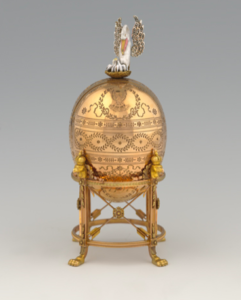
Photo Katherine Wetzel @ Virginia Museum of Fine Arts
Conclusion
A correct translation has made it possible to resolve the seemingly insoluble questions related to the thought, design, and meaning of the work of the craftsman Carl Fabergé. The unfortunate consequences of a poor translation were that the true intellectual value and status of the egg as a historical monument were obscured. The vague wording pushed the reader to search for a hidden biblical meaning, open to many interpretations, breaking with the generally accepted idea that any work by Fabergé is always clear in its meaning and intent. Abstract concepts and heavy religious imagery are not typical of any of the Easter eggs. Linking these two formulations to the mottos of the famous Office puts everything back in order: the egg is concise, symbolic, and constitutes high-level art, both an Imperial Easter gift of exquisite beauty and at the same time a bearer of historical truth.
The translation also gives us the opportunity to revisit the history of public education as well as social and charitable services in Russia, and in a broader context, in the world. The Office of Empress Maria was among the first and best in the world in the education of youth, particularly, as mentioned, young girls. Generations of well-educated people were trained and supported by this system. The traditions of the Russian intelligentsia find their roots there and have survived strongly despite the destruction wrought by the Bolsheviks after 1917. (For example, the main technical institution in Moscow during the Soviet era was the Moscow State Technical University, known as the Bauman School. This prestigious university was actually the Imperial Moscow Technical School, simply renamed after the October Revolution. This school was founded for orphans living at the Moscow Foundling Home at the end of the 18th century. It was so successful that in 1868, it obtained university status. It had a considerable influence on the development of many sectors of Russian industry before the Revolution and, by maintaining a high level of education, it perpetuated this tradition in the Soviet and post-Soviet eras.)
The new authorities closed and destroyed the Office, and did their best to erase all traces of it by spreading misinformation. This explains why few people, even in contemporary Russia, know this important aspect of history, which could nevertheless serve as a worthy and inspiring example of the practical application of progressive ideals. There is immense potential in studying the success of these services offered by the Office, as we are still faced today, in Russia, the United States, and throughout the world, with many challenges related to the improvement of the human condition.
© 2011 Elena A. Lioubimova ((Elena A. Lioubimova on http://pelicanegg.com)) & Igor Carl Fabergé Foundation, Geneva
All rights reserved. No part of the content of this publication may be reproduced without the written permission of the publisher.