
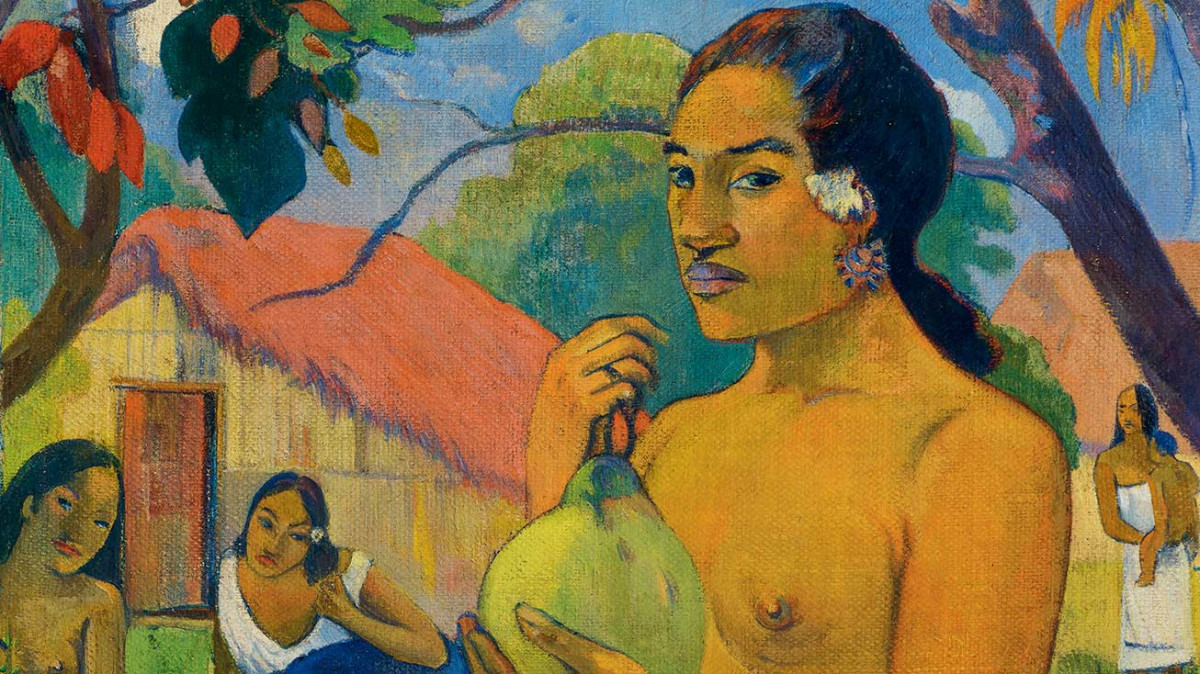
Paul Gauguin, Eü haere ia oe (Where Are You Going?), Woman with a Fruit, 1893, oil on canvas, 92.5 × 73.5 cm, State Hermitage Museum, Saint Petersburg / Paul Gauguin
Since the beginning of the Russian offensive in Ukraine, many voices have called for the French State to confiscate the works of the Morozov Collection currently on display at the Fondation Louis Vuitton.
The shockwave of the Russian invasion of Ukraine is currently shaking the world of culture. Cinema, music, dance, museums, the art market—no field is spared. Some turn art into a weapon of resistance, resigning, condemning, or bearing witness; others are already suffering the full brunt of the disasters of war, such as the Ivankiv Museum and its collection of naive art, which was set on fire by Russian troops. From Moscow to New York, hundreds of cultural institutions, museums, galleries, concert halls, and theaters are attempting to adapt to the impact of the crisis on their activities: exhibition projects are being suspended, tours canceled, and breaths held. In France, attention is crystallized on the case of the prestigious Morozov Collection, exhibited at the Fondation Louis Vuitton. Will the works be returned to Russia at the end of the exhibition on April 3rd?
A nationalized collection
Since September 22, the Fondation Louis Vuitton in Paris, owned by the LVMH group (editor’s note: majority shareholder of “Connaissance des Arts“), has been hosting 200 masterpieces from the Morozov collection, an exceptional ensemble of modern art assembled in the early 20th century by brothers Mikhail Abramovich Morozov (1870-1903) and Ivan Abramovich Morozov (1871-1921), great Russian patrons and collectors. Among the iconic works it houses, currently on display in Paris, are notably The Prison Courtyard (1890) by Vincent Van Gogh, the Portrait of Ambroise Vollard (1910) by Pablo Picasso, and Henri Matisse’s Moroccan Triptych (1912-1913).
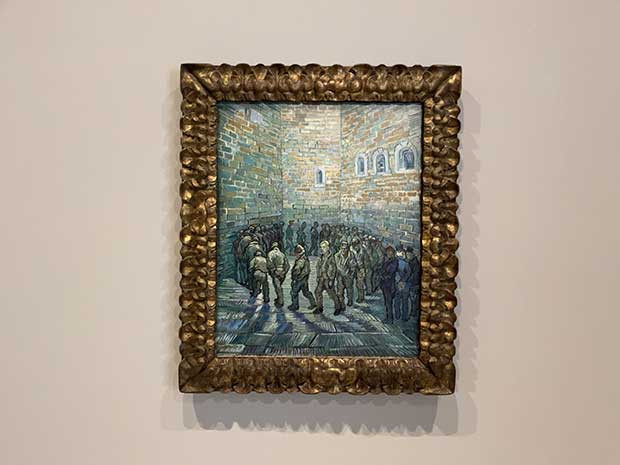
Vincent van Gogh, Prisoners’ Round, Saint-Rémy, 1890, oil on canvas, 80 × 64 cm, Pushkin State Museum of Fine Arts, Moscow, presented at the Fondation Louis Vuitton in Paris.

Valentin Serov, Portrait of the collector of modern Russian and French painting Ivan Abramovich Morozov, Moscow, 1910, Tempera on cardboard, 63.5 × 77 cm, State Tretyakov Gallery, Moscow
The unseizability of the works
It took years of negotiations between the partner states and institutions, but above all the endorsement of Vladimir Putin himself, for the Fondation Louis Vuitton exhibition to come to fruition. While the insurance value of the loaned works has not been officially revealed, it is estimated to be around 2 billion euros. A major cultural event, the exhibition at the Fondation Louis Vuitton in Paris was originally scheduled to end on February 22, but was extended a few weeks ago until April 3 and has just surpassed one million visitors.
The loan and insurance contracts that were renegotiated currently allow the Parisian institution to remain the custodian of the works until April 6. A decree, established in February 2021 and extended for the occasion, guarantees the unseizability of the works by France until that date. This is based on Article 61 of the law of August 8, 1994, according to which: ” Cultural property loaned by a foreign power, a public authority, or a foreign cultural institution, intended to be exhibited to the public in France, is unseizable for the period of its loan to the French State or to any legal entity designated by it. A joint order from the Minister of Culture and the Minister of Foreign Affairs establishes, for each exhibition, the list of cultural property, determines the duration of the loan, and designates the organizers of the exhibition. “

Kazimir Malevich, Portrait of Mikhail V. Matyushin, 1913, oil on canvas, 106.6 x 107.3 cm, Moscow, Tretyakov Gallery.
The works of the Morozov Collection presented in Paris are therefore considered untouchable until April 6, but according to the “Quotidien de l’art,” the effect of the unseizability order could be maintained until May 15. While it is currently not envisaged for France to proceed with an actual seizure of the works, it could nevertheless immobilize them, considering that their return to Russia cannot be carried out under optimal conditions of safety and security.
Museums in waiting
As Jean-Paul Claverie, advisor to Bernard Arnault, CEO of LVMH, recently explained to our colleagues at “Le Figaro“: ” As of this moment, I have received no calls from the embassy or from Russian museums. I remind you that our responsibility is the protection of the works. We will therefore ensure their return to their museums as agreed. If the conditions for them to travel safely prove insufficient, we will wait .” The Victoria and Albert Museum (V&A) in London is currently facing the same situation. The institution is indeed hosting until May 8 the exhibition “Fabergé in London: Romance to Revolution,” which brings together 200 pieces by the famous jeweler to the tsars, including the prestigious Moscow Kremlin Egg (1906), on loan from the Moscow Kremlin Museums, as well as the Alexander Palace Egg (1908), adorned with portraits of Tsar Nicholas II and his family, and the Romanov Tercentenary Egg (1913). The V&A states that it “remains in contact with the Department for Digital, Culture, Media and Sport (DCMS) on the evolving situation in Ukraine” and specifies that it has received “no requests for the return of works from Russian institutions” to date.
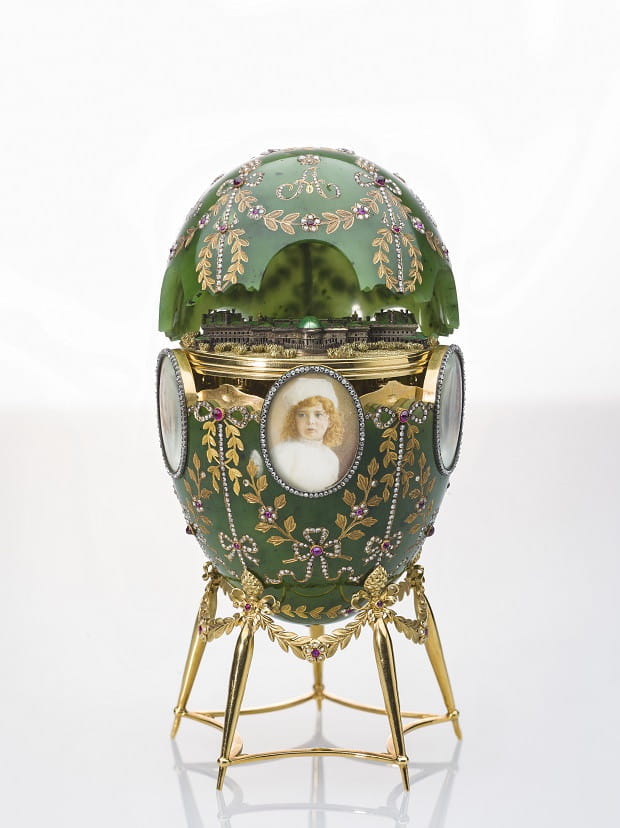
Fabergé, Alexander Palace Egg, 1908, gold, silver, precious stones, glass, wood, velvet, and bone ©Moscow, Kremlin Museums
In his column on February 25, Michel Guerrin, editor-in-chief at “Le Monde,” nevertheless questioned the wisdom of keeping the Morozov Collection exhibition open, which, according to him, “is part of Russian soft power.” However, the foundation’s management does not intend to suspend the exhibition at this stage. “More than Russia, it is the visitors who would be penalized,” explains its representative, specifying that the foundation is not turning a blind eye and is waiting to see the evolution of the conflict and what the Élysée decides, as reported by “Le Monde.”
In Russia, the European spirit blows
Placed under the dual sign of art and diplomacy, the Morozov Collection exhibition is based on a long-term partnership with Russia, with the Parisian institution notably committing to financing restorations or modernization projects for Russian museums.
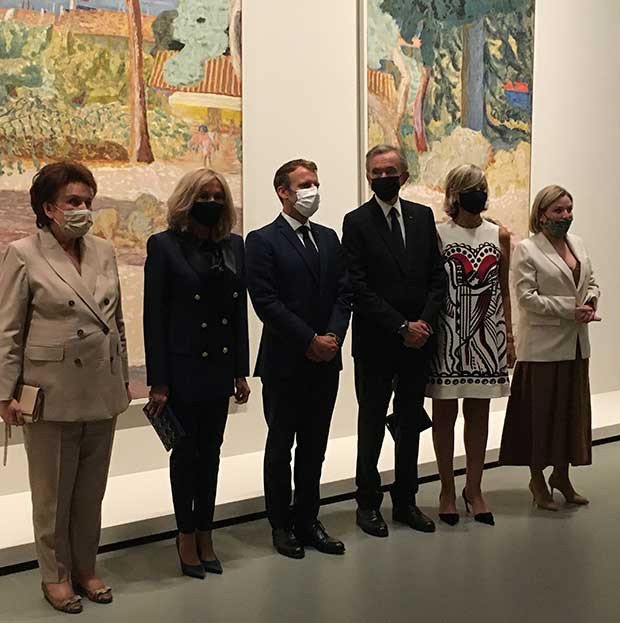
Roselyne Bachelot, Brigitte Macron, Emmanuel Macron, Bernard and Hélène Arnault, and Russian Minister of Culture Olga Lyubimova at the inauguration of the Morozov Exhibition at the Fondation Vuitton, in front of the triptych The Mediterranean by Pierre Bonnard (1911) ©Connaissance des Arts/Valérie Bougault
At its inauguration on September 21, in the presence of Olga Lyubimova, Russian Minister of Culture, President Emmanuel Macron emphasized the significance of this remarkable project, reaffirming the ties that unite Russia with Europe: “[this exhibition] is part of what binds President Putin and myself. It stands against anyone who would want to convince us that Russia is not a European land. The Morozov brothers captured the talents of Bonnard and Picasso, intimately understood the great transformations of French and European art at the end of the 19th century. In the intimacy of their gaze, where we find our imaginary lives, there is the clear trace that in Russia, the European spirit blows .” One week after the start of the Russian invasion of Ukraine, this statement obviously takes on a very different dimension and reminds us that no economic or political ambitions can prevent the arts from responding to one another, from resonating across borders, and that souls, in reality, have no nation.