
When one mentions the jewellers of the Russian Imperial Court, the first name that comes to mind is Karl Fabergé, creator of the famous Easter eggs, precious cigarette cases, and simpler objects that members of the tsar’s family gave one another. However, the honorary title of Court Jeweller or Court Supplier was also held by other masters of gold and silver.
Jérémie Pauzié
Favorite of three empresses, Pauzié became famous by crafting the Great Imperial Crown for Catherine II’s accession to the throne in 1762. This same crown adorned the heads of subsequent emperors up to Nicholas II. Composed of two hemispheres symbolizing the union of East and West, the crown is decorated with 4,936 Indian diamonds totaling 2,858 carats, 75 pearls, and is surmounted by an immense spinel. Despite this, its weight is not very significant, slightly less than two kilograms, and it was completed in a record time of two months.
Pauzié was a great master of stone cutting, primarily diamonds, which were always highly prized by his patronesses, the crowned heads Anna Ivanovna, Elizabeth Petrovna, and Catherine II. Under their reign, the court literally shone. Pauzié recounts in his memoirs of life in Russia: “The diamonds of the court ladies majestically adorn the crowd” and “even in private, they never divest themselves of their precious ornaments.”
The Swiss-born Pauzié arrived in Russia as a child. According to legend, he arrived in Saint Petersburg on foot with his father, having been invited by a relative who was a surgeon at the court of Peter I. His father passed away shortly thereafter, and the son became an apprentice to Gravero, a French gem cutter.
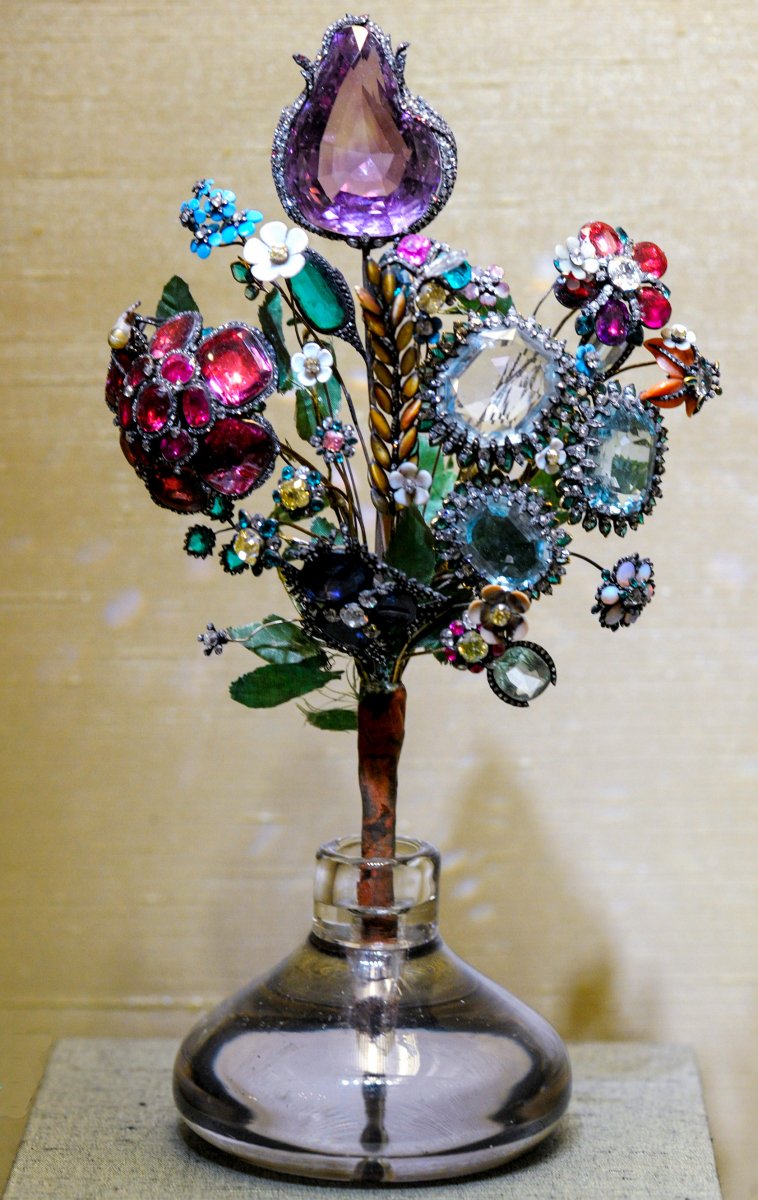
Gem bouquet, 1740